

For the better part of a decade, conservative investors were trapped in a financial desert. If you were looking for safety, you had to accept returns that barely outpaced inflation. In the world of Fixed Index Annuities (FIAs), this manifested as 3% or 4% “caps”—the maximum amount of growth you could earn in a year. It was the price we paid for protection against market losses, but it felt like a heavy toll.
Then, the landscape shifted. The Federal Reserve’s aggressive “higher for longer” interest rate stance, while a headache for homebuyers, has quietly created a “High-Rate Windfall” for those planning for retirement. Today, we aren’t just seeing 4% caps; we are seeing participation rates north of 100% and caps that haven’t been this high since 2014.
As a financial writer who has spent over a decade navigating the intersection of insurance and retirement planning, I’ve seen many market cycles. But the current environment for 2025 and 2026 is unique. To capitalize on it, you need to understand the “fuel” behind these numbers—what we in the industry call the Option Budget.
The Engine Room: Why Interest Rates Drive Your Growth
To understand why your retirement account might suddenly have more upside potential, we have to look under the hood of how an insurance company actually generates your return. Most people assume the insurance company is simply “investing in the stock market” on your behalf. That isn’t quite right.

When you put money into a Fixed Index Annuity, the insurance company places the bulk of that money into very safe, high-quality fixed-income assets, like corporate and government bonds. This is their “General Account.” Their primary goal is to ensure they have enough money to protect your principal if the market crashes.
The “windfall” happens because of the interest the insurance company earns on those bonds. When the Fed keeps rates high, the insurance company earns more interest. This interest is what they use to buy your “upside.”
Jargon Translation: The Option Budget
Think of the Option Budget as the “fuel” for your retirement vehicle.
- The Low-Rate Era: When interest rates were at 1%, the insurance company had very little “fuel” to spend. They could only afford small “options” (financial tools that track market growth), which resulted in low caps and low participation rates.
- The High-Rate Era: With rates sitting much higher, the insurance company’s “fuel tank” is full. They have more money to spend on the open market to buy higher caps and more aggressive participation rates for you.
Because the Federal Reserve has signaled that rates will remain elevated to combat persistent inflation, insurance companies are locking in these higher yields now. This is why the products hitting the market for 2025 and 2026 are some of the most competitive we’ve seen in a generation.

The Math of the Windfall: Participation Rates vs. Caps
In the past, most savers were familiar with “Caps.” If the S&P 500 went up 15% and your cap was 5%, you got 5%. It was simple, but often frustrating during bull markets.
In this high-rate environment, the industry has shifted toward Participation Rates. Instead of limiting how much of the growth you can keep (a cap), they define what percentage of the total growth you get. Because the Option Budget is so high right now, we are seeing participation rates exceed 100%.
Example: The 125% Participation Rate
Let’s look at the math. If you have an annuity with a 125% participation rate on a specific index, your interest credited is calculated as follows:

Interest Credited = (Index Growth × 1.25)
If the underlying index grows by 10% over your term, you aren’t just getting 10%. You are getting 12.5%.
In the “old” world of 4% caps, that same 10% market growth would have left you with 4%. In the “new” windfall environment, you are actually outperforming the index itself, all while maintaining a 0% floor that protects you if the market drops by 20%.
Evidence from the Field: Why 2026 is the Sweet Spot
Why am I specifically pointing to 2026? It comes down to the “lag effect” of bond ladders. Insurance companies don’t buy all their bonds on a single Tuesday. They buy them over time. As their older, lower-yielding bonds mature, they are reinvesting that money into today’s higher-yielding bonds.
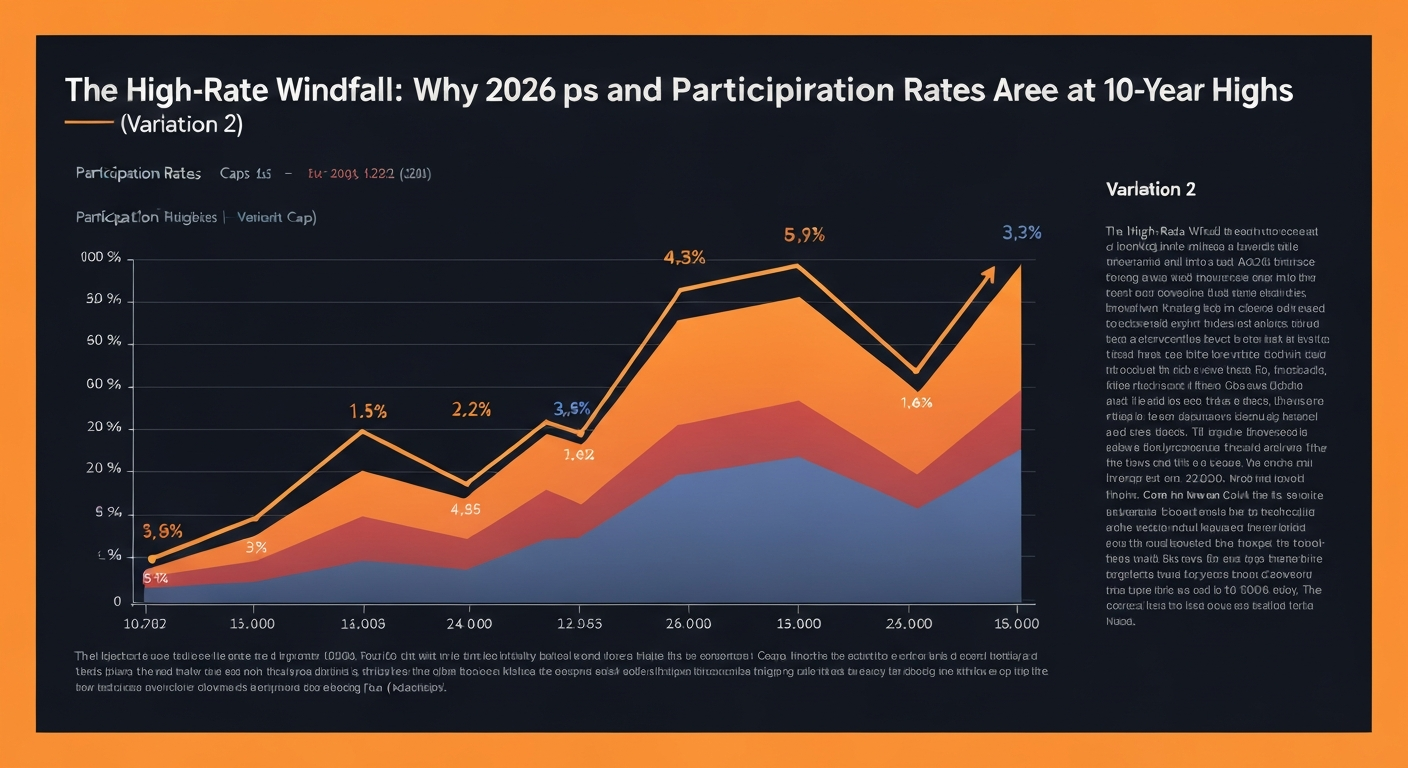
Data from the American Council of Life Insurers (ACLI) and recent quarterly statutory filings show that the “portfolio yield” for major carriers is trending upward at its fastest pace in decades. This means the “Option Budget” isn’t just a flash in the pan; it is a sustained increase in the company’s ability to offer better terms.
Furthermore, competition is at an all-time high. Asset managers and insurance carriers are fighting for “sticky” retirement dollars. This competition, combined with the Fed’s “higher for longer” policy, has forced carriers to pass that higher option budget directly to the consumer in the form of these record-breaking rates.
The Risk of Doing Nothing
The biggest risk in this environment isn’t market volatility—it’s inertia. Many retirees are still sitting in contracts they purchased five or six years ago. Those contracts were written in a low-rate environment. They likely have low caps, low participation rates, and high fees.
If you are holding a “legacy” annuity or keeping your “safe money” in a savings account earning 0.05%, you are missing the most significant tailwind for savers since the early 2000s. The 10-year highs we are seeing in 2026 rates represent a window of opportunity to “lock in” these higher budgets for the duration of a new contract term.
Actionable Steps: How to Capture the Windfall Today
You don’t need to be a macroeconomist to take advantage of this, but you do need to be proactive. Here is how I suggest you approach this high-rate window:
1. Audit Your “Renewal Rates”
If you already own an annuity, look at your most recent annual statement. What is your current cap or participation rate? Many older contracts have “renewal rates” that are significantly lower than what is being offered to new customers today. If your contract is out of its surrender period, it may be time to consider a 1035 exchange to a modern, high-rate product.
2. Prioritize “Uncapped” Strategies
In a high-rate environment, don’t settle for a 10% cap if you can get a 140% participation rate. Uncapped strategies allow you to benefit more fully from major market rallies, which is essential for keeping pace with the cost of living in retirement.
3. Diversify Your Indices
Don’t just stick to the S&P 500. With larger option budgets, carriers are offering fantastic rates on “volatility-controlled” indices that are designed to produce steady growth. Because the “fuel” (the option budget) is so high, these indices are often available with participation rates as high as 150% or 200%.
4. Review Your “Safe Money” Allocation
If you have cash sitting in CDs or money market accounts, ask yourself if that money is truly working for you. While CDs are also enjoying higher rates, they lack the tax-deferral benefits of an annuity and don’t offer the same “upside” potential that a high participation rate provides.

QCD Shield: Protect Wealth, Satisfy RMDs Tax-Free
The QCD Shield offers a strategic bulwark against the often-unseen erosion of wealth, presenting a sophisticated answer for those navigating the intricate currents of

Cash Balance Plans: A Strategic Path for Wealth
In an era where the meticulous preservation of capital dictates the survival of a family fortune across generations, how do astute business owners and partners

UAE: The Independent Producer & Global Capital Shifts
When a principal from a venerable European family office shared his trepidation over late-night calls from Riyadh, it wasn’t about a new investment, but